The making of Nosferatu: Negative rated at 320 ASA
Nosferatu. Kodak 500T given more light than its speed asks for, then pushed half a stop, for “a proper black.” How dark the finished film really is, and what to record when you shoot your own.
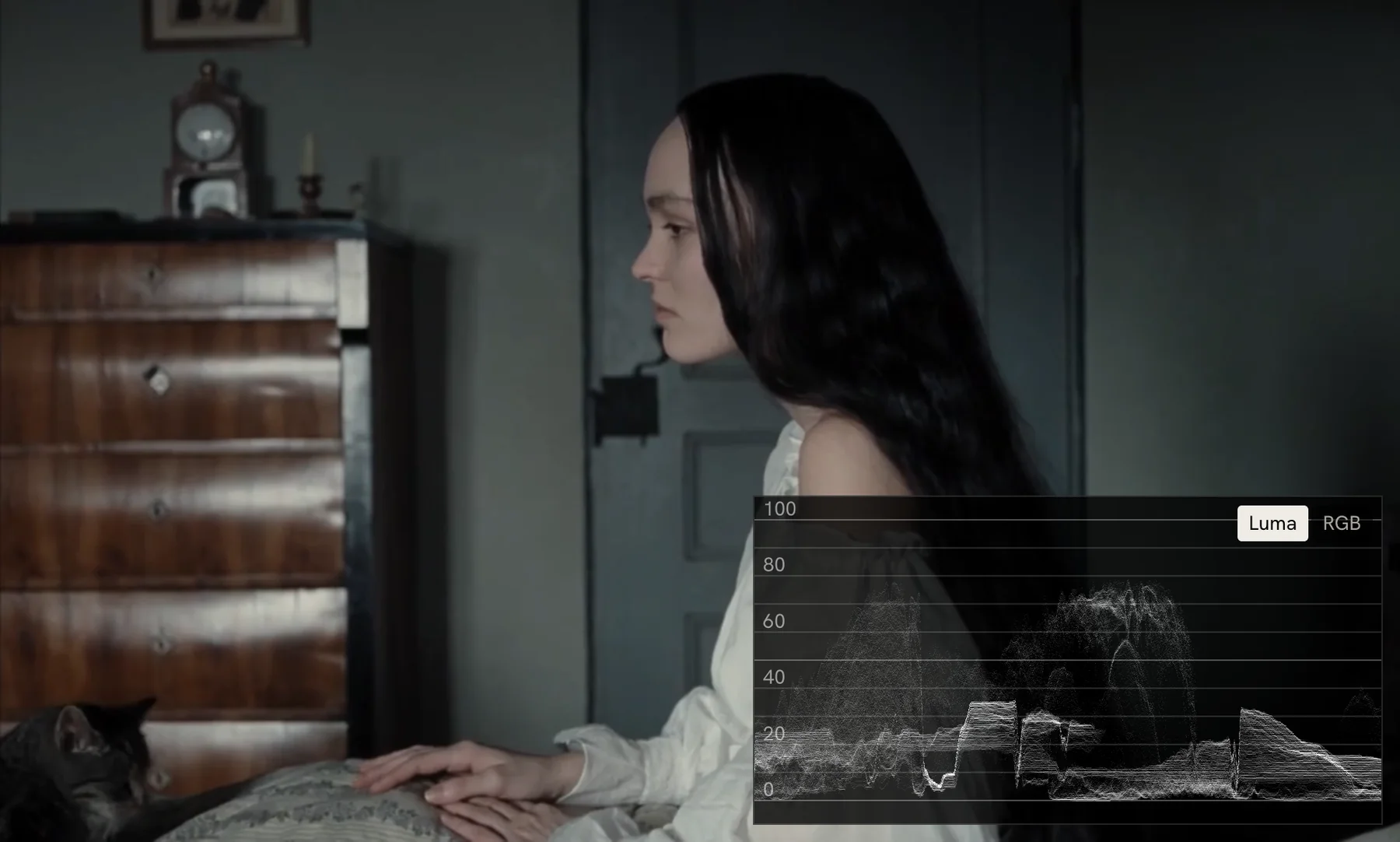
Lily-Rose Depp as Ellen Hutter, with the waveform in HorrorSet.
The finished frame
Ellen sits on her bed in a gray-blue room. On the waveform her face sits at 43 to 46 percent, her lit shoulder at 54 and the white nightgown at 71. The walls sit between 14 and 28, and her hair at about 2.
Nothing in the frame reaches 80 percent, and more than two thirds of it sits under 25.
Those are the levels of the release, after the grade. Aim for them in the grade. On the day, the camera should see more light than this.
More light than it looks
“Right now, I like a dense negative to separate the shadows and guarantee a proper black.”
Blaschke shot the whole film on Kodak Vision3 500T 5219. He rated it at 320 ASA, giving the negative more light than the stock’s speed calls for, and had every scene pushed half a stop in the lab.
A sensor behaves the same way in the shadows. Record a healthy exposure and bring it down in the grade, and the noise goes down with the picture, leaving the blacks clean. Record it dark and lift it later, and the noise comes up with them. ARRI’s manual describes setting exposure “to avoid clipped highlights or noisy shadows.”
On digital the limit is at the top. A highlight that clips is gone, so the brightest thing you care about sets how far you can go. In this scene that’s the white nightgown.
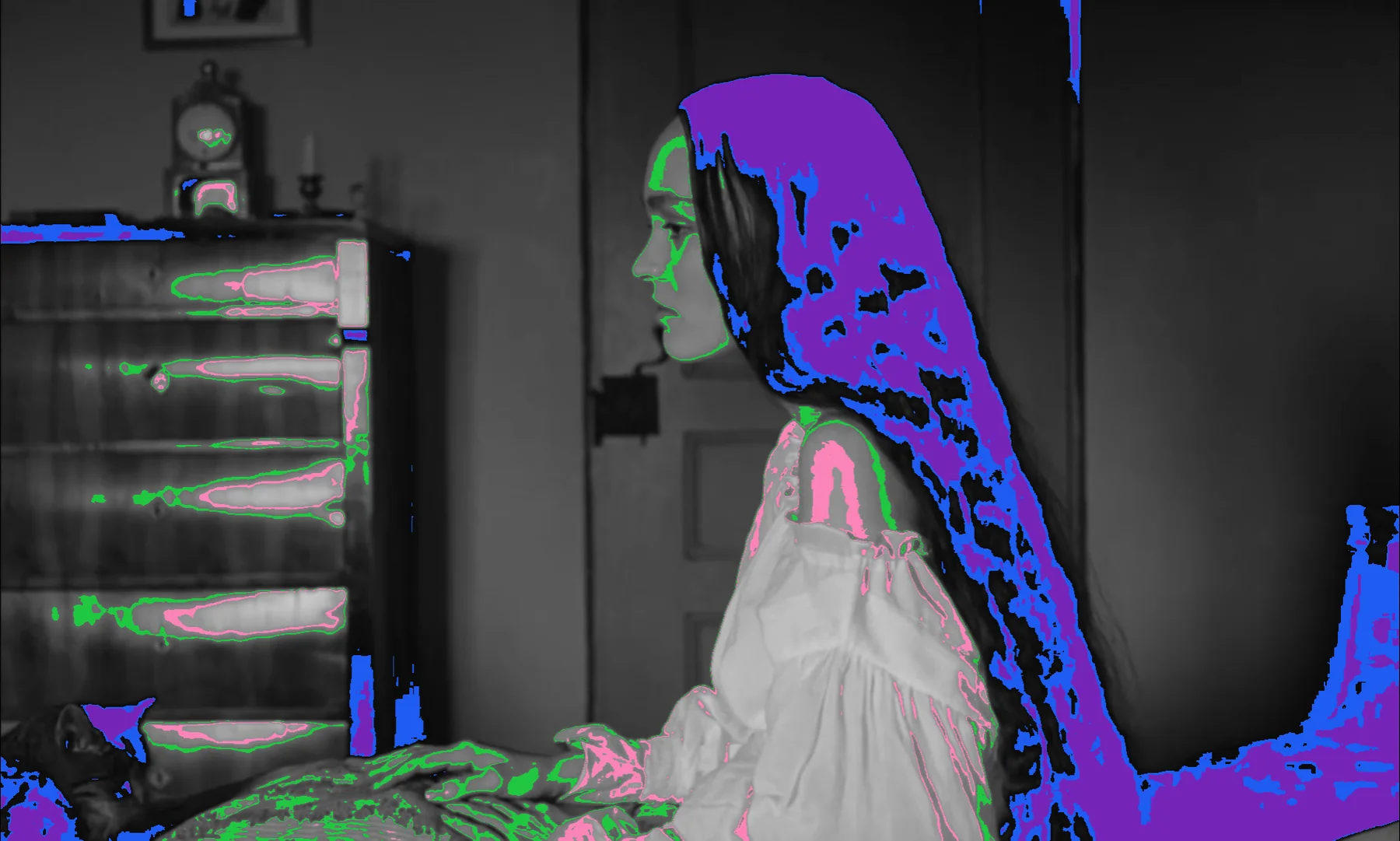
The same frame in false color.
False color
HorrorSet’s false color uses the scale on ARRI’s ALEXA, Mini and LF. The picture turns gray apart from six bands: purple for black clipping, under 2.5 percent; blue just above it, to 4; green for 18 percent gray, 38 to 42; pink for one stop over gray, 52 to 56, the level ARRI marks for skin; yellow just below clipping, 97 to 99; and red for clipping.
Here her face falls between green and pink, edged in green. The lit shoulder turns pink and her hair turns purple. On a camera, purple says the shadows hold nothing more. In a grade it can be the whole idea.
There’s no yellow or red, because nothing comes near clipping. Yellow covers the last two percent before white, so a graded film shows it only where a highlight is about to go. Across 1,992 stills in HorrorSet, about one in eleven shows yellow on more than a speck of the frame.
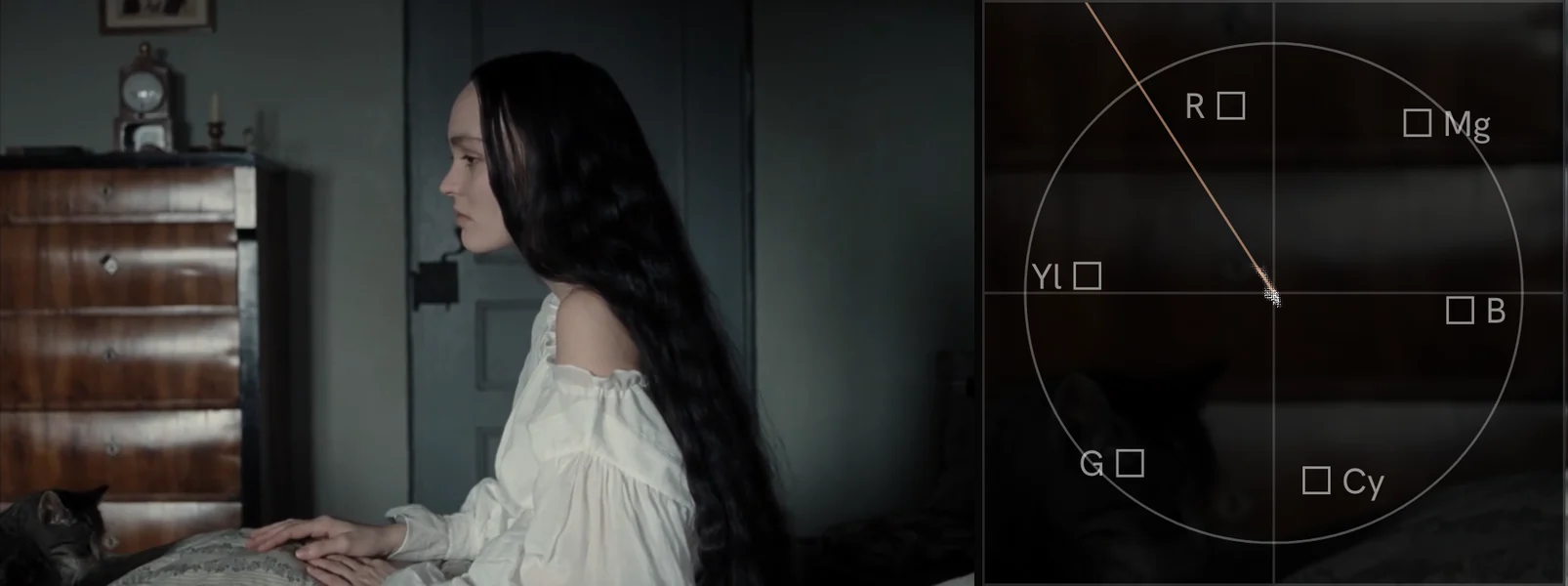
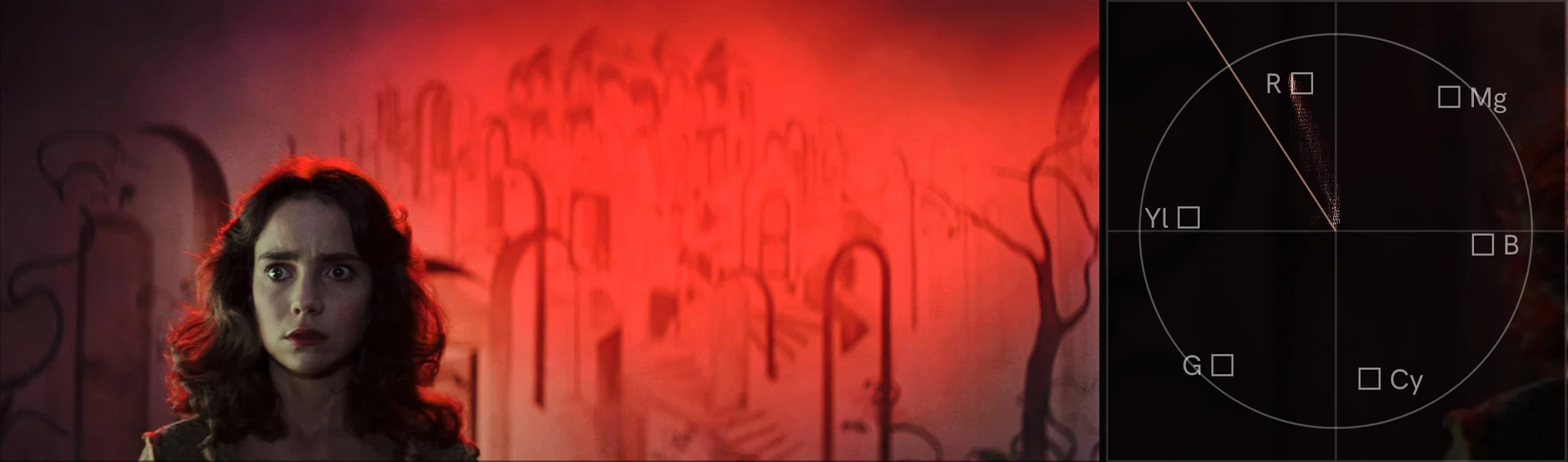
Nosferatu, above, and Suspiria, 1977.
The vectorscope
The vectorscope leaves brightness out and plots color. A point’s distance from the center is the strength of its color, and its direction is the hue, toward the boxes for red, magenta, blue, cyan, green and yellow. The line between red and yellow is the skin tone line, where faces tend to fall.
Ellen’s frame is a small knot at the center, leaning a little along the skin line: almost no color, and what there is runs warm. Suzy in front of the mural in Suspiria throws a long arm toward red. Measured over the whole frame, hers carries about fourteen times the color.
In front of the lens there’s little color to begin with: gray-blue walls, white cotton, dark wood. What’s left can come down in the grade, where it’s judged against the rest of the film.
ARRI and Blackmagic
Every manufacturer draws its own bands, and some read a different signal. Three you may meet:
ALEXA, Mini, LF
ALEXA 35
URSA Cine
Purple
Black clipping, 0 to 2.5%
Noise floor
Black detail loss
Blue
Just above black clipping, 2.5 to 4%
Edge of shadow detail
Near black detail loss
Green
18% gray, 38 to 42%
18% middle gray
Middle gray, 38.4%; a match for darker skin
Pink
One stop over gray, 52 to 56%
One stop above middle gray
One stop over middle gray; lighter skin
Yellow
Just below clipping, 97 to 99%
⅔ stop below clipping
From 80%, near white clipping
Red
Clipping, 99 to 100%
⅓ stop below clipping
From 95%, white clipping
On ARRI’s ALEXA, Mini and LF, false color reads whatever that output shows, or the Log C signal if you switch it to. ARRI recommends Log C when that’s what you record: “you will want to know the exposure levels of the signal you are actually recording.” It also warns that with a strong look on the monitor, false color can mislead.
The ALEXA 35 counts in stops and always reads LogC4, before any look. Middle gray lands at 28 percent LogC4, which ARRI puts at about 40 percent in Rec. 709.
Blackmagic’s URSA Cine places middle gray at 38.4 percent, the middle gray of Blackmagic Film, and suggests pink for lighter skin and green for darker skin. Its yellow begins at 80 percent and its red at 95. A reading on one camera doesn’t carry to another, so learn the bands of the one in your hands.
The URSA Cine’s own screen gives you false color, zebras and a histogram. For a waveform or a vectorscope, run SDI to a monitor that has them, such as Blackmagic’s Video Assist.
On the day
Light the ratios you want on screen: the face well above the walls, the white cotton the brightest thing, the hair close to black. The grade can lower everything at once. It can’t move light that went to the wrong place.
Expose for a dense negative. Put the face where your camera’s false color marks skin, keep the brightest white out of the red, and leave the darkness for the grade.
Read false color on the signal you record, with the look switched off.
Put a look on the monitors so the room sees the mood. The URSA Cine can send one of two display LUTs to each output.
Shoot a test first: the setup and a stand-in at your exposure, one stop over and one stop under. Grade all three toward the frame you’re after and keep whichever holds the white and the hair best.
“You can’t change the core quality of light in post – you’re not fooling anybody.”